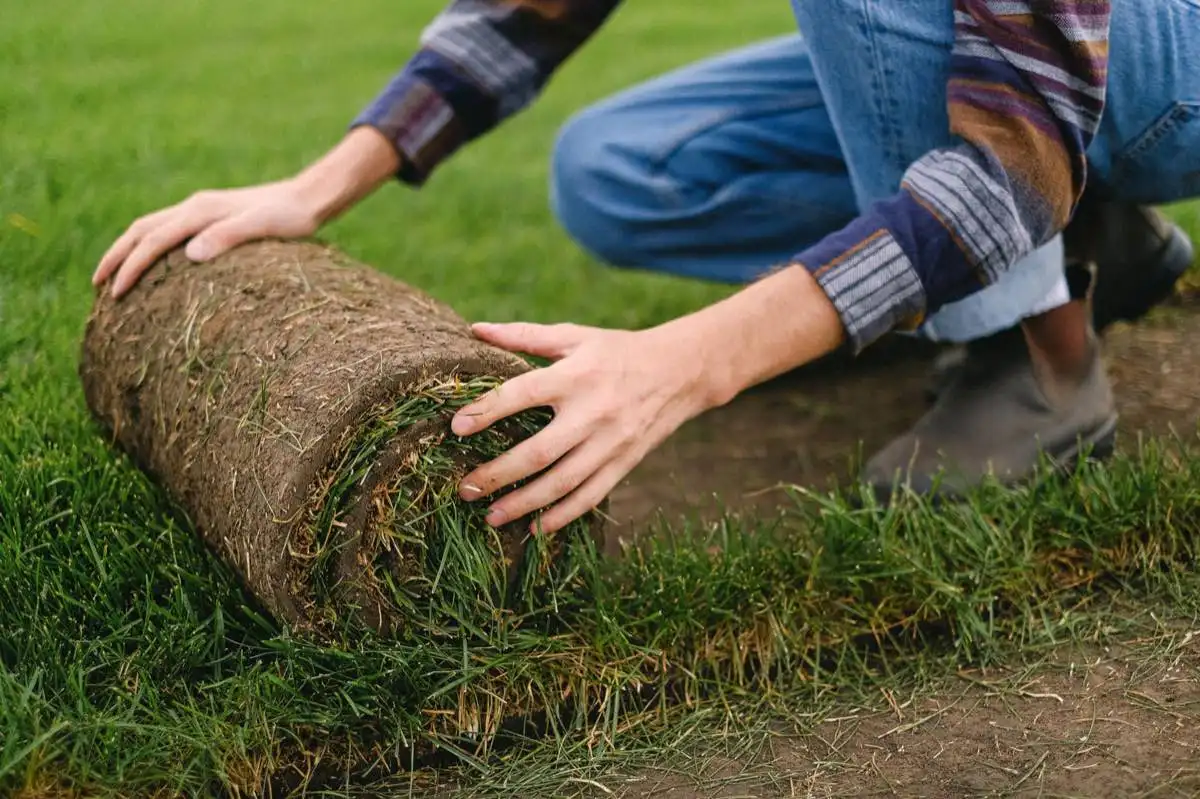
Seed costs about a fifth of what sod costs and takes about ten times longer to become a lawn. Sod runs $0.40 to $0.80 per square foot installed; seed runs $0.05 to $0.20 per square foot in materials. That gap is real, and it is also not the whole story.
The decision usually is not about money. It is about whether the grass you want even comes as seed, whether you have a slope, and whether you can tolerate three months of a yard that looks like a work in progress.
The comparison
| Sod | Seed | |
|---|---|---|
| Cost per sq ft | $0.40–$0.80 installed | $0.05–$0.20 materials |
| Lawn on day one | Yes | No |
| Walk on it | ~2 weeks | 8–12 weeks |
| Full establishment | 4–6 weeks | 2–3 months of growing season |
| Install window | Most of the growing season | Narrow, tied to soil temperature |
| Weed pressure during establishment | Very low | High |
| Works on a slope | Yes | Poorly |
| Grass varieties available | Whatever is grown locally | Far wider, if it seeds at all |
| Watering during establishment | Intense but short | Lighter but for months |
| Failure mode | Rare with proper water | Thin patches, common |
The point that settles a lot of arguments
Many of the best warm-season grasses cannot be grown from seed.
St. Augustine is not commercially available as seed at all — sod or plugs, full stop. The improved Bermuda hybrids that sports fields use, the Tifway and TifTuf class, are sterile and propagated vegetatively. Most named Zoysia varieties are the same.
So if you want any of those, the debate is over before it starts. Seeding limits you to common Bermuda, some Zoysia types with a slow and frustrating germination process, buffalo grass, and the cool-season grasses.
This is the fact that surprises most people mid-way through pricing a project.
Where seed genuinely wins
Large areas. The cost gap scales. On a quarter-acre, sod is a serious number and seed is a Saturday and a few hundred dollars in materials. Below about 3,000 square feet, the difference matters much less than people expect.
Grass variety choice, in the cool-season world. Fescue blends in particular give you options sod farms do not carry.
Patching and overseeding an existing lawn. Nobody sods a bare patch.
A yard you are not in a hurry about, and where the timing lines up with the right seeding window for your grass.
Where sod genuinely wins
Slopes and erosion. Seed on a slope becomes a green stripe at the bottom of the hill after the first real rain. Sod holds soil the moment it is laid and pinned.
Weed suppression. This is underrated. Bare soil for eight weeks is an open invitation, and you cannot use most pre-emergent herbicides because they would stop your grass seed too. Sod covers the ground immediately, so the weeds never get their window.
Timing flexibility. Seed has to go down when soil temperatures are right, which is a narrow window twice a year for most grasses. Sod can go down through most of the growing season.
Certainty. Sod either roots or it does not, and with proper watering it roots. Seeded lawns come in patchy, and the follow-up reseeding is a normal part of the process rather than a failure.
Dust, mud, and living with it. Two months of bare soil next to your front door is worse than it sounds, especially with kids or dogs.
The cost gap, more honestly
Seed's material advantage is real. What people forget to add:
- Water for two to three months instead of two to three weeks, over a much larger area of bare soil
- Weed control during establishment, and often a follow-up season of it
- Reseeding the thin areas, which is normal rather than exceptional
- Straw or an erosion blanket on anything with slope
- Time. Not free, if the yard is unusable for a season
A DIY seeded lawn done thoughtfully still comes in well under sod. Just not five times under.
Our recommendation
Sod if: the area is under about 5,000 square feet, there is any slope, you want St. Augustine or an improved Bermuda hybrid, the yard gets used, you are selling, or you want it done rather than in progress.
Seed if: the area is large, the budget is the binding constraint, you have the right seasonal window, the ground is flat, and you genuinely do not mind two or three months of the yard being a project.
And here is the honest version nobody selling either one will say: sod the front, seed the back. The front yard is what you and everyone else look at, it is usually the smaller area, and it is where instant results are worth paying for. The back is bigger, less scrutinized, and a fine place to spend $150 on seed instead of $2,000 on sod. We have suggested this split on plenty of quotes and it makes people happier than either extreme.
The thing that decides it either way
Soil preparation. Sod on bad soil fails. Seed on bad soil fails harder.
Kill the old growth, fix the grade — the code standard is a fall of at least six inches within ten feet of the foundation — loosen the top four to six inches, work in compost, and use a starter fertilizer with phosphorus rather than a high-nitrogen lawn feed. Our guide to preparing a yard for sod applies almost identically to seed.
Skimp there and you have bought an expensive way to grow weeds.
When you do not need us at all
A flat back yard under 2,000 square feet, in the right season, with decent existing soil, is a straightforward DIY seeding project. Rent a slit seeder rather than broadcasting by hand — seed-to-soil contact is the whole game — keep the top half inch damp for two to three weeks, and be patient.
Call someone when there is grading to fix, drainage problems, a slope, heavy clay or new-construction fill, or an area big enough that hand work stops making sense.
Amarillo Elite Sod & Turf installs Bermuda sod and other warm-season varieties across Amarillo and the Texas Panhandle, along with the soil prep and grading that make either method work. For pricing, see our sod installation cost guide or our grass type comparison.
Get a free quote → · call (844) 511-2320
Ready for a free quote in Amarillo?
Amarillo Elite Sod & Turf — free estimate, clear scope, no pressure. Use the form on this page or jump to the homepage quote.
Related services in Amarillo
Amarillo Elite Sod & Turf money pages — go straight to the service you need.
- Bermuda Sod →
Bermuda sod is the toughest, thirstiest-in-reverse lawn you can grow in Amarillo, and the only thing standing between it and a clean record here is winter. We install the cold-hardy Oklahoma State lines — Tahoma 31, Latitude 36, NorthBridge and Patriot — because the Panhandle sits at the northern edge of Bermuda's comfortable range, and the southern cultivars sold two hundred miles down the road do not always come back in April.
- Land Grading & Leveling →
Land grading and leveling is the part of a lawn nobody sees and everything else depends on. We laser-grade Amarillo yards to a fall of roughly a quarter inch per foot away from the slab, fill the low spots and cut a route for water to leave, because standing water rots new sod no matter which variety goes on top of it.
- Topsoil & Soil Amendment →
Topsoil and soil amendment is what you are really buying when you buy a lawn, because the four inches under the grass decide almost everything that happens afterwards. Panhandle soil tests come back calcareous and alkaline — commonly pH 7.6 to 8.3 with free lime in the profile — which is exactly why brand-new turf goes pale yellow six weeks after install while the owner swears they fertilized it.
- Buffalo Grass Sod →
Buffalo grass sod is the only lawn on our list that was already growing here before anybody drilled a water well, and on the Southern High Plains that stops being sentimental and starts being practical. Buffalograss, Bouteloua dactyloides, is the native short grass of this exact prairie, it will hold a lawn on roughly half the irrigation a Bermuda yard wants, and we install it as sod in Prairie, Legacy, Density and Bowie.
- Kentucky Bluegrass Sod →
Kentucky bluegrass sod gives you a genuinely green lawn in March and November, which no warm-season grass in Amarillo will ever do for you. At 3,600 feet in zone 7a it is a legitimate choice rather than a stretch — the same grass that fails in Houston works here, because our winters are cold enough and our nights cool off.
Frequently asked questions
Is sod or seed cheaper?
Seed, by a lot on materials — roughly $0.05 to $0.20 per square foot versus $0.40 to $0.80 installed for sod. The gap narrows once you count the extra irrigation, the weed control through establishment, and the reseeding most people end up doing on the thin spots.
How long does seed take to look like a lawn?
Germination takes one to three weeks depending on the grass, and a genuinely full lawn takes two to three months of growing season. Sod is a lawn the day it is installed and is rooted enough to walk on in about two weeks.
Can you seed St. Augustine grass?
No. St. Augustine is not commercially available as seed and has to be established from sod or plugs. Most improved Bermuda hybrids are the same — they are sterile and propagated vegetatively. If you want those grasses, the sod-versus-seed debate is already settled.
Is sod better than seed on a slope?
Considerably. Seed on a slope washes into a stripe at the bottom with the first heavy rain, and you reseed. Sod holds the soil the moment it is pinned down, which is why erosion control jobs use sod almost exclusively.
Does sod root as deeply as seeded grass?
Eventually, yes. A seeded lawn develops its root system in place, which some people argue gives a slight early advantage. Two seasons on, a properly installed and watered sod lawn is indistinguishable underground. Soil preparation matters far more than which method you used.
Can you lay sod over an existing lawn?
No. It has to come out or be killed off first. Sod laid over living grass does not root into it — the old turf dies underneath and rots, giving you a spongy, uneven lawn and every weed that was already there.
Local context
How this applies in Amarillo, TX
Every article here is written from sod installation work done in Amarillo and the Texas Panhandle, so the numbers reflect local labour, permit and material costs rather than a national average. Your own job can land either side of them depending on access, the condition of what is already there, and the materials you pick — Prairie buffalograss sod, Legacy buffalograss, Bowie buffalograss.
The way to turn any of this into a real answer is to have someone look at your actual situation. The free estimate is free, itemized and written down, with no deposit and no obligation. Call (844) 511-2320 or start on the Amarillo Elite Sod & Turf homepage.
Areas Amarillo Elite Sod & Turf covers
Amarillo first, then the surrounding communities of the Texas Panhandle. Each has its own page with local detail rather than a copy of this one:
- Pampa, TX — Gray County, population 16,867 at the 2020 census
- Hereford, TX — Deaf Smith County, population 14,972 at the 2020 census
- Canyon, TX — Randall County, population 14,836 at the 2020 census
- Dumas, TX — Moore County, population 14,501 at the 2020 census
- Borger, TX — Hutchinson County, population 12,551 at the 2020 census
- Dalhart, TX — Dallam and Hartley counties, population 8,447 at the 2020 census
Or jump to the full list of Amarillo services.
The Amarillo Elite Sod & Turf Team
Licensed sod installation pros in Amarillo, TX
Written by the Amarillo Elite Sod & Turf team — licensed, insured sod installation pros with 15+ years serving Amarillo, TX and the surrounding area.